Elder's Triple Screen is a way of reading three time frames at the same time. The wave is the long-term trend, the tide is the medium-term move inside it, and the ripple is the short-term timing. I built it for the quant trading module at SMU, and it is the one piece of coursework that is still in the platform today.
Wave, tide and ripple
The universe is filtered first on fundamentals and on stocks that are trending upward. That is the wave, and it does most of the work. Even when it does not give a clean directional call it narrows the universe down to names moving the right way.
Then an oscillator on a shorter time frame shows where in the pattern a stock currently sits. That is the tide. The ripple is a simple EMA cross, which gives a specific entry at a set time of day.
So the strategy finds stocks on the way up, asks two more indicators to confirm it, and only enters when all three agree. It exits when they start to turn. It will never call a top or a bottom exactly right, but across the win and loss profile it comes out profitable.
What the backtest showed
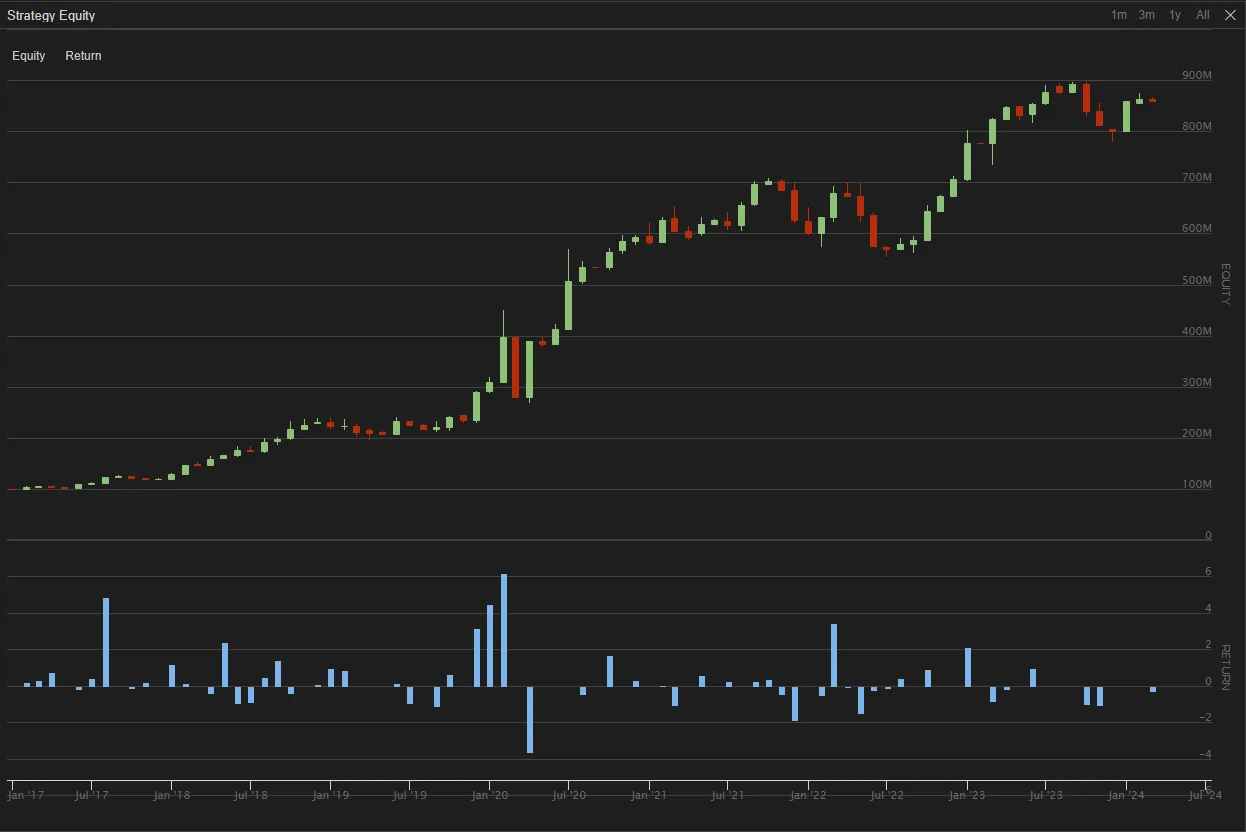
I fitted it in-sample on 2017 to 2019, then tested it out-of-sample from 2019 to 2024. It performed well over both periods, but with a maximum drawdown close to 40%.
That drawdown is the number that matters. The equity curve hides it because the strategy grows so much over the period, which is exactly why I would not lever this up.
Where it broke, which was the useful part
The most informative result was a negative one. When I added volume-based slippage in full percentage points, the strategy fell apart.
The cause was the universe screener. The way it sorted had pushed selection toward high volume, high market cap names, so the book was concentrated exactly where that slippage model punishes hardest. My read at the time was that those names probably do not slip that way in practice, and I still think that is right. But the honest version is that the result was very sensitive to an assumption I had not thought about properly, and finding that out in a backtest is a lot cheaper than finding it out live.
What I changed afterwards
Two things came out of it. The first was splitting the alpha signals into separate indicators instead of one lump of logic, so the pieces are modular and can be recombined.
The second was moving hedging out of the strategy entirely. A hedge written inside a strategy only protects that strategy. Written at the portfolio level it protects the whole book, which by then held more than just this one. That idea is what the risk overlay layer in Argus turned into.